· ReadyStack
Worked example
Real numbers from this tool, line by line.
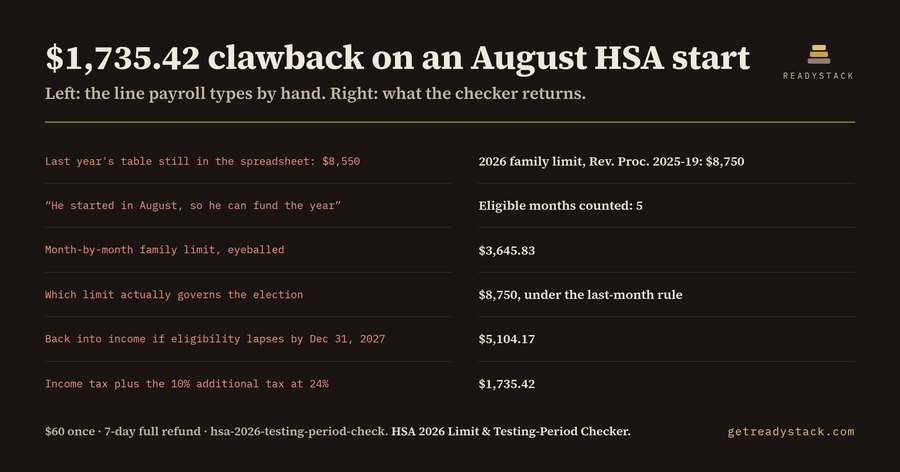
$1,735.42 of tax hangs on one line in a US payroll administrator's spreadsheet: the family HSA election of an employee whose high-deductible plan started on August 1, 2026.
He joined the family HDHP on August 1 and asks the obvious question: can he still put the full $8,750 into his HSA this year? Payroll checks the annual limit and says yes.
Payroll is right. That is the part that makes this expensive.
The rule that says yes
The last-month rule treats anyone HSA-eligible on December 1 as eligible for the whole year, so an August start does not cap the contribution at five twelfths. He may fund the full $8,750 for 2026.
What the rule attaches is a testing period. It runs from December 1, 2026 through December 31, 2027 - thirteen months. Stay HSA-eligible for all of it and nothing happens. Break it, and the difference between the full-year limit and the month-by-month limit stops being a contribution and becomes income.
What the difference is worth
Count the months he is eligible on the first day of the month: August through December. Five. The month-by-month family limit is $8,750 x 5/12 = $3,645.83.
The governing limit under the last-month rule is $8,750. The gap between them - $5,104.17 - is the amount at risk.
If eligibility lapses before December 31, 2027, that $5,104.17 goes into gross income for 2027 and carries a 10% additional tax on top of the ordinary tax. At a combined marginal rate of 24%, the bill is $1,735.42.
Nothing about that break has to be dramatic: a job change in March 2027, a spouse's PPO, or Medicare Part A at 65. Each ends HSA eligibility, and each is invisible to the payroll system that processed the 2026 election.
The other failure
Run the same election the other way: eligible from January 1, but out of the HDHP on June 30. Without eligibility on December 1 the last-month rule does not apply, and the limit is the month-by-month one: $4,375.
The employee has already run $8,750 through payroll. The excess is $4,375, and an excess contribution draws a 6% excise tax for every year it stays in the account - $262.50 a year, on Form 5329, until it is withdrawn with its earnings.
Why the annual limit is not the answer
Every free HSA calculator will tell you the annual limit. The year has to be right first: the 2025 limits were $4,300 self-only and $8,550 family, and IRS Rev. Proc. 2025-19 sets 2026 at $4,400 and $8,750. A stale table hands you the old numbers with the same confidence as the new ones.
Even with the right year, the annual limit answers a question nobody is asking. The question is whether this employee, with this start date and this plan for 2027, may fund the year - and what it costs if the answer is no.
What the extension does
Enter the coverage tier, the HDHP start date, the last 2026 month of eligibility, whether the employee reaches 55, the employee and employer dollars, the marginal rate, and whether eligibility survives all of 2027.
It returns the eligible month count, both limits, which one governs, any excess and its 6% excise, the testing-period add-back, the tax on it, and the total exposure. Every calculation is free, in the popup and on the web page, with no key, no cap and no watermark.
The $60 key does not unlock an answer. It exports the finished audit as a .csv you own, and it arms two browser alarms: the December 1, 2026 eligibility snapshot, and the December 31, 2027 testing-period close - the date that decides whether that $5,104.17 was a contribution or income.
A CPA bills $150 to $400 an hour in 2026, and a Form 1040-X to unwind one wrong HSA year runs $200 to $1,500.
Questions people ask
What does the HSA 2026 Limit & Testing-Period Checker actually do?
It takes one 2026 HSA election - coverage tier, the date HDHP coverage started, the last month of eligibility, catch-up age, employee and employer dollars - and returns the month-by-month limit, the last-month-rule limit, which one governs, any excess and its 6% excise, and what the 13-month testing period costs if eligibility lapses.
Who is this for?
US payroll and benefits administrators who process mid-year HSA elections, plus the CPAs and enrolled agents who clean them up in January. If you have ever had to decide whether an employee who joined the HDHP in August may fund the full $8,750, this is that decision, priced.
Why will a free chatbot not do this?
A general chatbot answers from whatever year's table it learned, and nothing in the answer tells you which year you got: 2025 was $4,300 and $8,550, 2026 is $4,400 and $8,750. Generic HSA calculators stop at the annual limit, so they never price the 13-month testing period, which is where the real money sits.
What is free and what needs the key?
Every calculation is free, unlimited and key-free: proration, the last-month rule, the excise and the testing-period add-back, in the popup and on the web page. The $60 key changes the axis, not the answer - it exports the audit as a .csv you own and sets the two reminder alarms.
What would this cost without the tool?
A CPA bills $150 to $400 an hour in 2026, and unwinding one wrong HSA year through a Form 1040-X amended return runs $200 to $1,500. One August-start family election carries $5,104.17 of testing-period add-back; at a 24% marginal rate that is $1,735.42 of tax.
Ask about this tool
One question, answered by the person who built it. Your email only if you want the answer sent.